
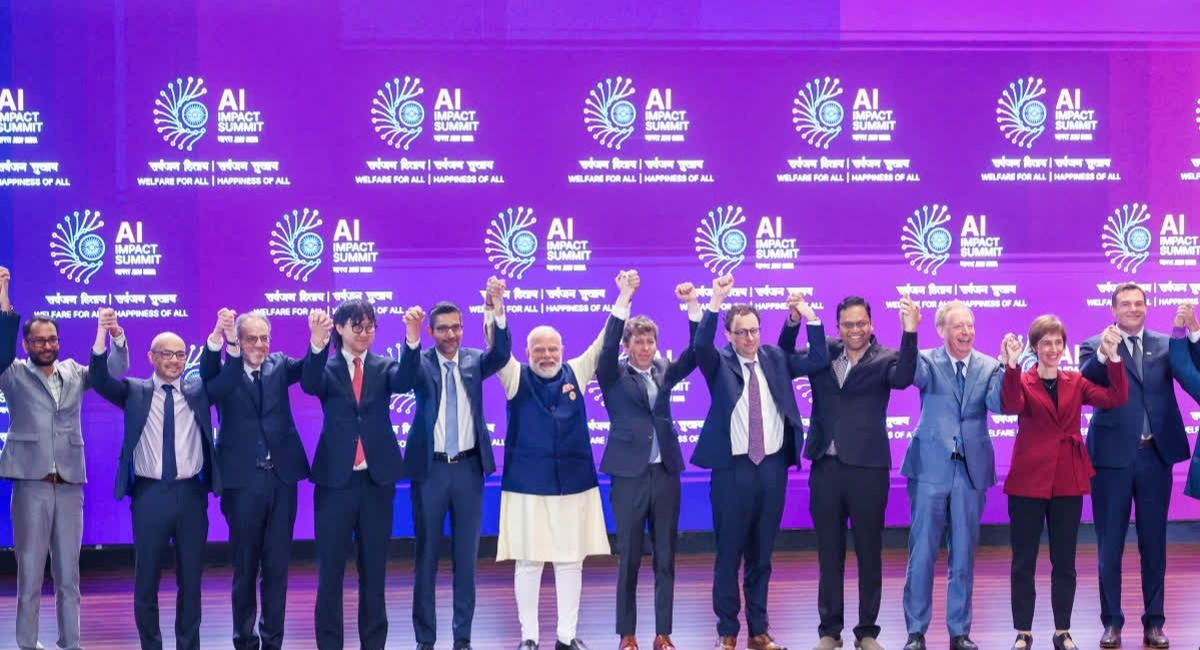
The opening session of the India AI Impact Summit at Bharat Mandapam was less ceremonial and more declarative. Inaugurated by Narendra Modi, the summit positioned India not just as a fast-scaling AI market, but as an active architect of the global AI order one increasingly defined by geopolitics, compute dominance and governance frameworks.
The underlying message was clear: artificial intelligence has moved beyond being a sectoral innovation to becoming a national capability, demanding scale, sovereignty and international coordination.
India’s Full-Stack AI Vision
Union Minister for Electronics and IT Ashwini Vaishnaw outlined India’s AI roadmap as a five-layer stack encompassing applications, models, compute infrastructure, talent and energy. The focus, he stressed, was on deployment at population scale embedding AI across healthcare, agriculture, education and public services rather than treating it as a purely experimental technology.
The approach mirrors India’s Digital Public Infrastructure philosophy, where scale enables inclusion. Technology, Vaishnaw noted, must be designed “for the many, not the few,” placing governance and accessibility at the centre of AI development.
AI as Core Infrastructure
From industry, N. Chandrasekaran, Chairman of Tata Sons, framed AI as “the infrastructure of intelligence,” likening its impact to steam power, electricity and the internet. His remarks reflected a growing consensus that competitive advantage will accrue to nations that control the full AI stack from semiconductors and systems to energy and applications.
Yet Chandrasekaran also pointed to a paradox of the AI age: while intelligence becomes abundant, trust, stewardship and human capability may emerge as the scarcest resources.
Speed, Scale and Risk
Global AI leaders underscored the pace of change. Dario Amodei, CEO of Anthropic, described progress since the 2023 Bletchley Park summit as exponential, warning that systems approaching or exceeding human-level cognition across domains could arrive sooner than anticipated.
His metaphor of a potential “country of geniuses in a data centre” captured both the upside scientific breakthroughs and poverty reduction and the downside, including systemic risk and labour disruption. Coordinated action between governments and companies, he argued, is essential to ensure broadly shared gains.
The Platform Shift
Sundar Pichai, CEO of Google, described AI as the most significant platform shift of a generation, with the power to accelerate discovery and allow emerging economies to leapfrog legacy constraints. But he cautioned that without responsible development and supportive policy, the digital divide could evolve into a far deeper AI divide.
Governance Takes Centre Stage
For António Guterres, the summit marked a turning point in global AI governance. Hosting a major AI forum in the Global South, he said, reshaped who gets to influence AI’s future. He highlighted recent UN initiatives, including an independent international scientific panel on AI and a Global Dialogue on AI Governance, while calling for a Global AI Fund to build capacity in developing nations.
The signal was unmistakable: AI governance is shifting from voluntary principles to durable institutional frameworks.
Strategic Autonomy in the AI Era
French President Emmanuel Macron framed AI as a geopolitical asset on par with energy and defence. Drawing parallels between India’s digital public infrastructure and Europe’s regulatory stance, he emphasised sovereign capability and strategic autonomy. The most effective AI, he argued, is not necessarily the most expensive, but the one designed for the right purpose.
A Pivotal Moment
Across the opening session, three themes consistently surfaced: scale, safety and sovereignty. India articulated its ambition to democratise AI through population-scale deployment. Industry leaders highlighted exponential capability growth and commercial opportunity. Global institutions pressed for guardrails and inclusive governance.
By convening heads of state, Big Tech CEOs and multilateral leaders in New Delhi, India positioned itself not as a downstream consumer of AI systems, but as a co-author of the rules governing their evolution. In a world where compute clusters rival oil fields in strategic value, the summit suggested the contest is no longer just about who builds the most powerful model but who defines the framework within which that power operates.